Monotheism vs. Symbolism
A Dialogue on Divine Transcendence and Sacred Form
In the long history of theological dispute, few questions have generated more heat — or more light — than this one: does the use of sacred images bring the worshipper closer to the divine, or does it corrupt the very concept of God that worship is meant to honour? It is a debate that has crossed every major tradition and every major century. And its two most philosophically rigorous answers come from traditions that have rarely been placed directly in conversation.
The Islamic philosophical and theological tradition is anchored by a single, non-negotiable principle: Tawhīd — the absolute, unqualified oneness of God. From this flows the doctrine of tanzīh: the utter transcendence of God from all creaturely attributes, including form, composition, and limitation. To represent God through any finite object — however devoutly, however symbolically — is to risk shirk: the association of something created with the Creator, the gravest error in Islamic theology. Ibn Sīnā grounds this in metaphysics: the Necessary Existent is absolutely simple, without parts or boundaries. Al-Ghazālī grounds it in epistemology: the heart must be directed toward the Real, not toward a substitute that displaces it. Ibn Taymiyyah grounds it in revelation: the prohibition is not a philosopher's preference but a divine decree.
The Hindu philosophical tradition — particularly in its Advaita Vedantic and Vaishnava forms — takes a different starting point. Adi Shankarācārya teaches that Brahman, the ultimate reality, is indeed formless and attribute-less. Yet the human mind does not begin in the formless. It begins in names, forms, and relationships. The sacred image — the pratīka, the symbol; the mūrti, the consecrated icon — is not God confined to stone. It is a conceptual foothold: a means by which the finite mind moves toward what is infinite. Swami Vivekananda calls this the natural progression of the spirit from the lower truth to the higher. Chaitanya Mahaprabhu goes further: the divine not only permits but welcomes such a relationship, appearing in form so that love — prema — can find an object worthy of it.
What makes this dialogue philosophically rich is that both sides agree on more than they disagree. Both affirm an ultimate reality that transcends ordinary experience. Both are suspicious of naïve literalism. Both insist that the inner orientation of the worshipper matters more than the external form. The disagreement is precise and profound: whether the use of finite form is a permissible stage in the ascent toward the infinite — or an intrinsic distortion of what the infinite is.
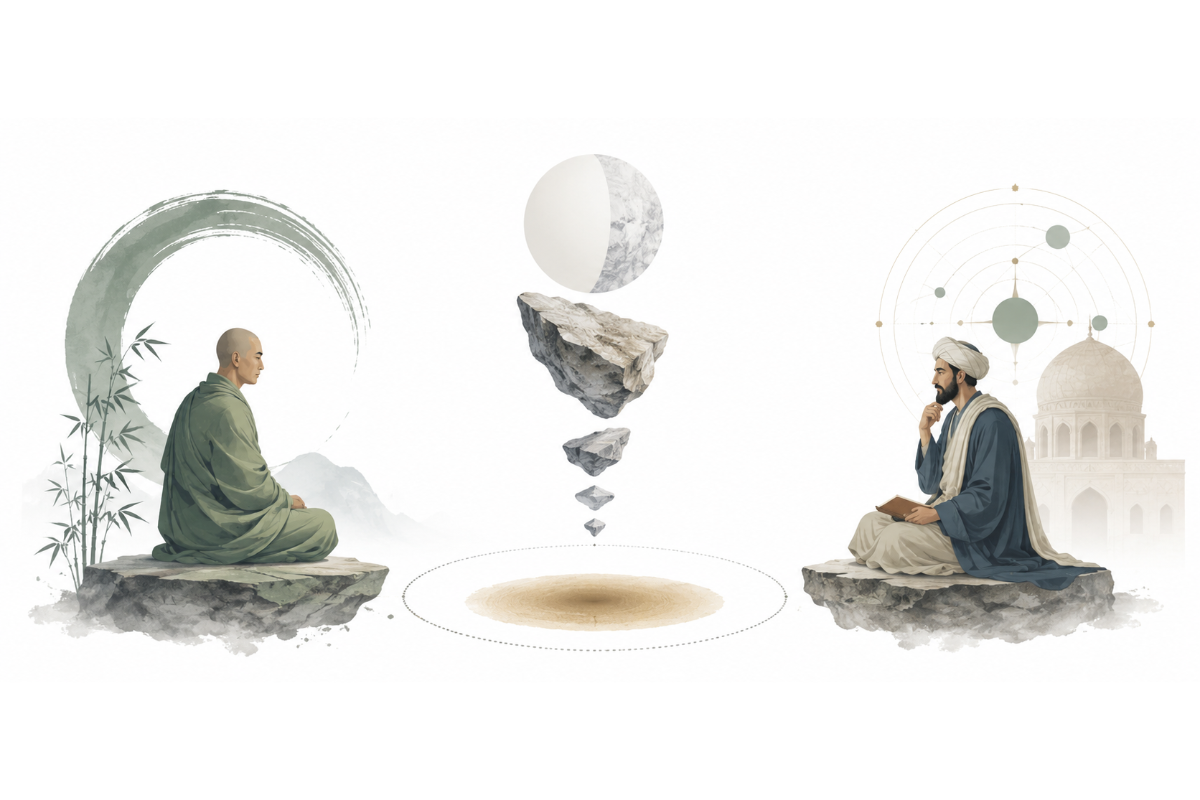
The conversation that follows brings eight thinkers into direct engagement — five from the Islamic tradition, three from the Hindu — not as representatives of a culture war, but as philosophers wrestling with a shared question. The format is a structured symposium: each voice speaks from its own tradition with its strongest arguments, and the exchanges move through four key questions:
- Is the sacred icon a philosophical concession to human limitation — or a philosophical error?
- What does the method of worship reveal about the worshipper's conception of God?
- Can the infinite genuinely be approached through the finite, or does the finite always distort what it represents?
- Where, ultimately, is the line between symbol and idolatry — and who has the authority to draw it?
You do not need to arrive with a position. Arrive with the question. That is what these thinkers have done, across centuries and civilizations, and it is what the best philosophical conversations always require.