The God Debate
Nine Philosophers on the Most Contested Question in History
The question of God's existence is the oldest and most consequential question in the history of thought. It underlies every debate about the nature of morality, the meaning of death, the foundation of science, and the purpose of human life. Every major civilisation has answered it. In the modern era, two answers have been developed with exceptional philosophical rigour — and they have never been brought into more direct, or more evenly matched, confrontation than in this dialogue.
The case for atheism here is not the casual scepticism of someone who "just doesn't believe." It is the sustained, argued, historically informed position of five thinkers who have each spent their careers dismantling the intellectual case for God from a different angle. Bertrand Russell applies the strict standards of empiricism: extraordinary claims require extraordinary evidence, and none has been provided. Richard Dawkins argues that natural selection renders the design argument not merely wrong but unnecessary — biology has no need for a creator, and adding one creates more explanatory problems than it solves. Christopher Hitchens prosecutes religion itself: not just the philosophical arguments but the historical record, which he argues demonstrates that organised belief in God has produced more suffering than consolation. Sam Harris contends that morality must be grounded in the wellbeing of conscious creatures — not divine command — and that neuroscience, not theology, is the appropriate tool for ethics. Friedrich Nietzsche occupies the most radical position: he does not merely deny God's existence but diagnoses the death of God as the defining cultural event of modernity — a collapse that will require human beings to create meaning from nothing, or to descend into nihilism.
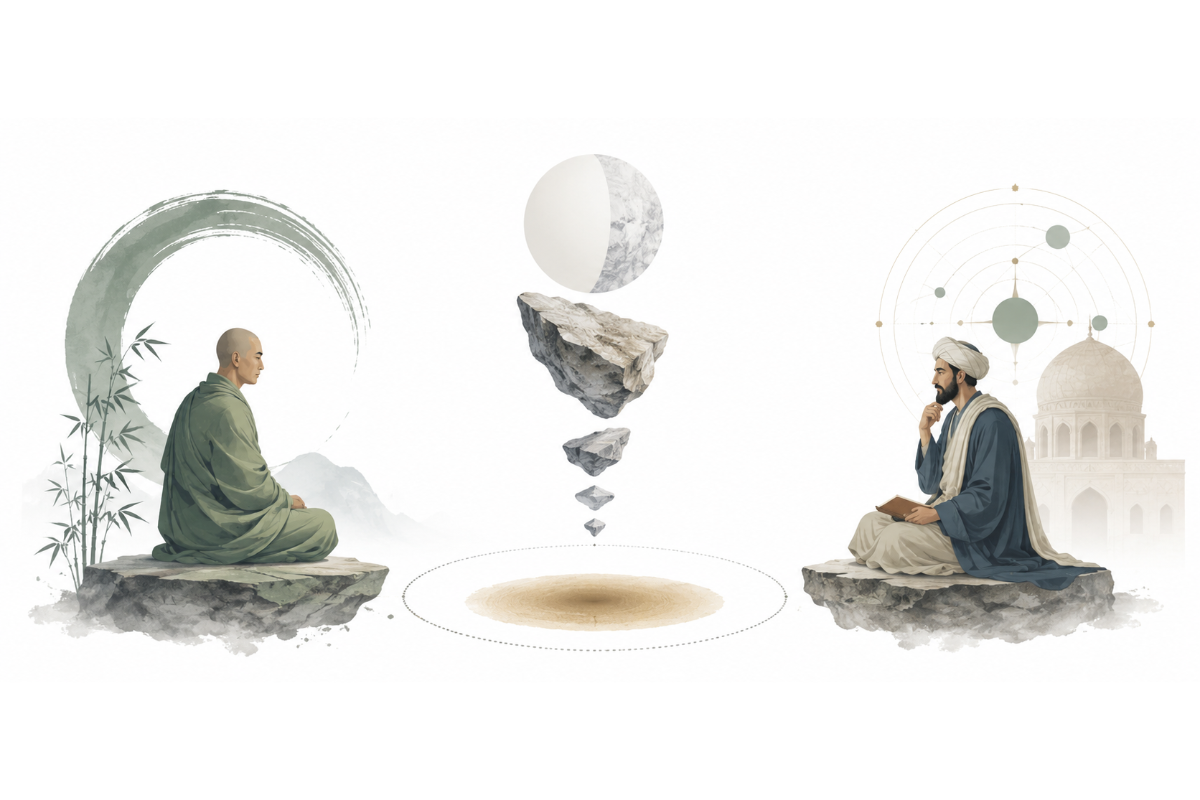
Against this formidable assembly, four voices from classical Islamic philosophy mount a defence that is neither defensive nor evasive. Ibn Sīnā (Avicenna) begins not with Scripture but with pure reason: the existence of contingent beings — beings that exist but need not have — logically entails the existence of a Necessary Being whose essence just is existence itself. This is the Wājib al-Wujūd argument, and it is not answered by pointing to natural selection, because it is a question about why there is existence at all rather than nothing — a question that science, by design, does not address. Al-Ghazālī presses a different point: that reason alone is insufficient to map the full range of human knowledge, and that the prophetic revelation of Islam is not an abandonment of reason but its completion. Ibn Rushd (Averroes) — the great commentator on Aristotle, who insisted on the harmony of philosophical truth and religious truth — argues that apparent contradictions between reason and revelation arise from misreading one or the other. Fakhr al-Dīn al-Rāzī synthesises logic and Islamic theology into a comprehensive rational defence of theism that engages Aristotle, the Mutakallimūn, and the emerging natural philosophy of his era.
The exchanges in this dialogue cover the territory that matters most. Does natural selection settle the cosmological question — or does it simply describe the mechanism within an existence whose ground remains unexplained? Is the problem of evil a logical refutation of theism, or does it rest on a particular conception of God that Islamic theology does not hold? Can morality be grounded in science — and if so, does that make it stronger or more contingent? And is Nietzsche's "death of God" a liberation or a catastrophe — and for whom?
- Does science explain the existence of the universe — or only what happens within it?
- Is the problem of evil a refutation of God — or a misunderstanding of what theism claims?
- Can morality survive without a transcendent ground — or does secular ethics rest on borrowed metaphysics?
- What follows for human life if the answer to the question of God is no?
The court, as always, is reason. But reason has more participants — and more to say — than this debate is usually given credit for.