Zen, Art, and Minimalism
The Difference Between an Empty Room and an Empty Mind
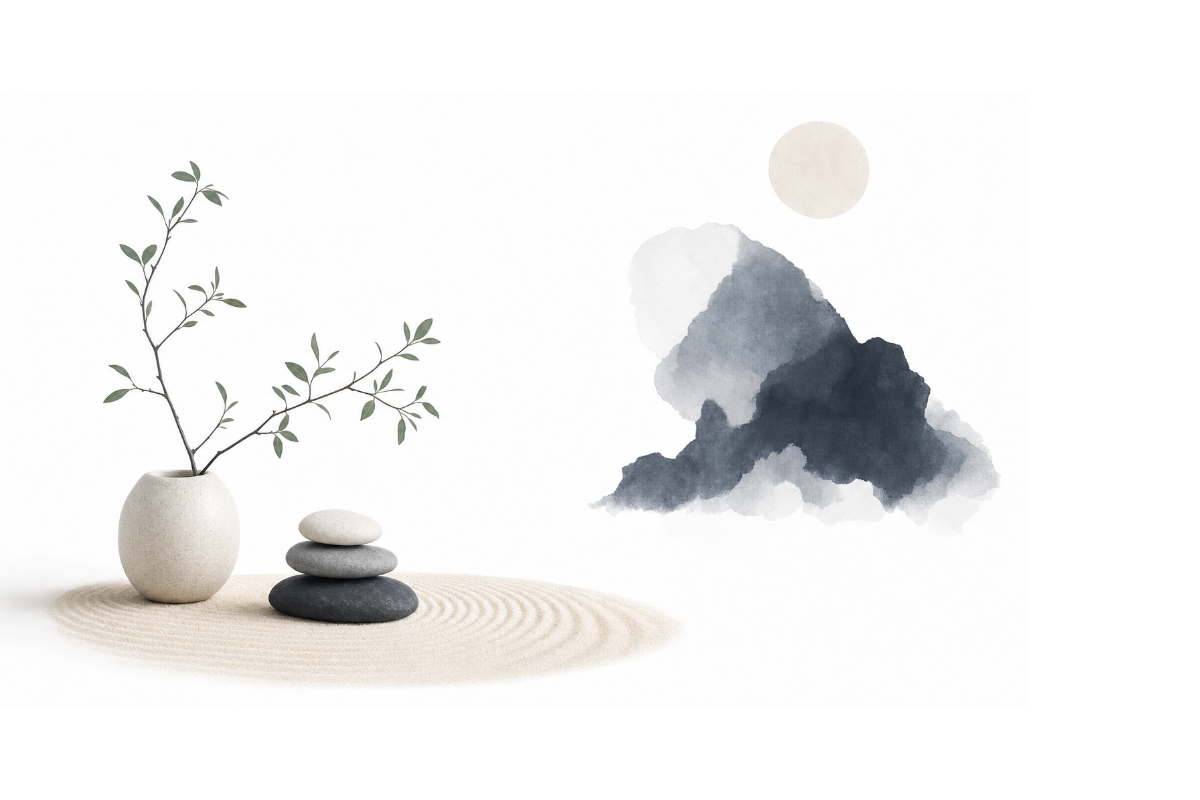
There is a word in Japanese — ma — that has no precise English translation. It refers to a pause, a gap, an interval: the space between notes that makes music possible, the silence between words that gives speech its shape, the emptiness in a room that allows the room to breathe. Ma is not the absence of something. It is a presence of a different kind. And understanding the difference between this and the Western concept of "negative space" — let alone the contemporary minimalism of decluttered apartments and capsule wardrobes — is the difference between a philosophy and an aesthetic.
Zen Buddhism, which developed in China as Chan and matured in Japan over seven centuries, is not primarily a religion of doctrine or a set of ethical rules. It is a practice of direct attention — of stripping away the layers of concept, habit, and distraction that separate the practitioner from the bare fact of experience. The great Zen master Dōgen taught that practice and enlightenment are not sequential — they are simultaneous. You do not practise in order to become enlightened later. The practice is already the enlightenment, if done with full presence. From this comes the characteristic Zen approach to art, craft, and space: not as decoration or expression, but as practice — as dō, a path. Hence chadō (the way of tea), shodō (the way of calligraphy), kadō (the way of flower arrangement). In each case, the art is a means of attentional training, not a product to be admired.
The Western minimalism that emerged in the twentieth century — from the severe geometric abstraction of Malevich and Mondrian to the "less is more" architecture of Mies van der Rohe, from the white rooms of John Pawson to the decluttering advice of Marie Kondo — draws partly on Japanese aesthetic influence and partly on modernist ideals of functional clarity. It is a genuine artistic movement with a genuine philosophy. But it is not Zen. And the confusion between the two — between simplicity as lifestyle choice and simplicity as the natural expression of a mind no longer grasping — is the philosophical question this dialogue was designed to surface.
The key Zen aesthetic concepts are worth naming before the conversation begins. Wabi-sabi is the acceptance of impermanence and imperfection as the condition of beauty — the cracked glaze on the tea bowl, the moss on the stone. Mushin is the state of "no-mind" — action without the interference of deliberate thought — that the Zen tradition cultivates through practice. Mu is emptiness as a positive condition: not the emptiness of a room that has been cleared, but the emptiness of a mind no longer filled with the chatter of self-reference. Shibumi is the quality of understated elegance that emerges not from reduction but from refinement — the difference between a bare wall and a wall that has been prepared with care.
This dialogue brings a Zen Master — who speaks from this tradition, drawing on Dōgen, Huang-po, and the contemporary teacher Shunryu Suzuki — into conversation with an Art Historian who has spent a career studying the lineage of minimalism in the Western and Japanese visual traditions. They do not simply disagree. They discover, through careful exchange, that they are sometimes talking about the same thing and sometimes about things that look identical but are not.
- Is an empty room the same as an empty mind — or can one produce the other?
- What does Zen Buddhism actually teach about aesthetic experience — is beauty a distraction or a doorway?
- Where does the Western minimalist tradition genuinely converge with Zen, and where does it diverge?
- Can a consumer movement — a market for "simple living" — carry genuine philosophical content, or does the commercialisation of minimalism undermine it at the root?
The question is not whether your room is tidy. The question is whether the one who tidies it has understood what the tidying is for.