Kierkegaard's Case for the Leap of Faith
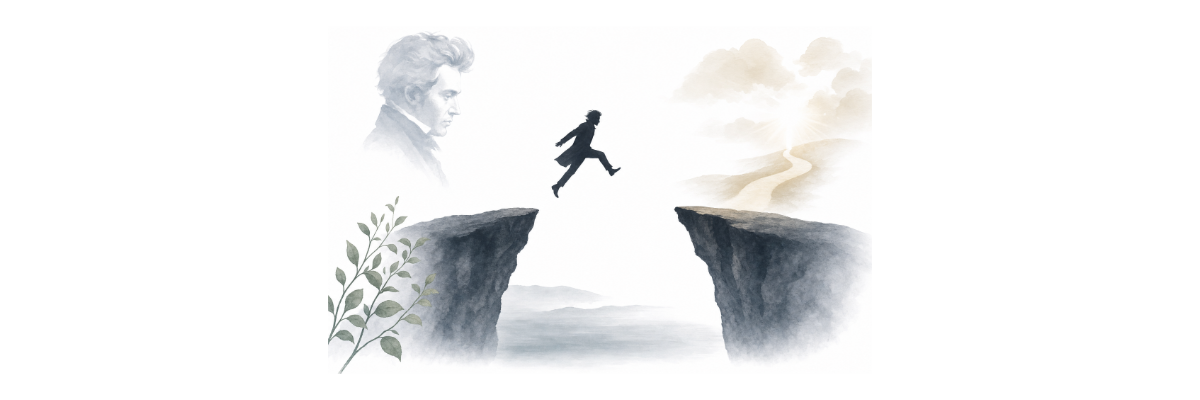
In 1843, Kierkegaard published one of philosophy's most unsettling books — a meditation on a man commanded by God to kill his son. What he found in that story was not a moral lesson but a terrifying diagnosis of what faith actually demands.
In 1843, Søren Kierkegaard published a book under the pseudonym Johannes de Silentio — John of Silence — that remains one of the most uncomfortable texts in the history of Western philosophy. It is a meditation on forty verses from Genesis: the story of Abraham, commanded by God to travel to Mount Moriah and sacrifice his son Isaac. The book is called Fear and Trembling, and its title comes from Paul's letter to the Philippians: "Work out your salvation with fear and trembling."
Kierkegaard chose a pseudonym deliberately. John of Silence cannot make the movement he describes. He can only observe it, admire it, and confess that he cannot follow. This is the first signal that Fear and Trembling is not a defense of faith in the comfortable sense — not a theological argument that ends with God vindicated and Abraham praised. It is an attempt to say what faith actually costs, and to find that the cost is higher than any philosopher or comfortable churchgoer has been willing to admit.
The Four Versions of the Story
The book opens with what Kierkegaard calls the Exordium — four brief retellings of the Abraham story, each imagining that something went differently. In one version, Abraham goes through with the act but loses his faith on the mountain: he cannot reconcile a God who would demand this with a God worthy of worship. In another, he survives but is broken — his son grows up haunted by what his father was willing to do. In a third, Abraham asks God's forgiveness for having been willing.
Each version is an attempt to imagine Abraham doing something other than what Genesis records. Each fails to capture the actual Abraham — the one who went in faith, who believed that somehow the thing God had promised (that Isaac would be the father of nations) would still come to pass, even though God was demanding Isaac's death. Kierkegaard offers these variations not to undermine the original story but to make visible, by contrast, how extraordinary the actual faith is. The Abraham who loses his faith, the Abraham who breaks — these are recognisable human responses. The Abraham who believes is something else entirely.
The Tragic Hero and the Knight of Faith
To sharpen what is distinctive about Abraham's situation, Kierkegaard introduces two contrasting figures. The first is the tragic hero. Agamemnon, who sacrifices his daughter Iphigenia for the sake of the Greek fleet. Jephthah, who sacrifices his daughter to fulfill a vow. Brutus, who condemns his sons for treason against Rome. Each of these figures gives up something beloved — a child, a bond — for the sake of a higher ethical demand. The universal moral law requires it. The community understands the sacrifice. The tragic hero can be mourned, admired, and comprehended.
Abraham cannot. His situation is structurally different from the tragic hero's. Agamemnon sacrifices the particular (his daughter) for the universal (the welfare of his people). The ethical — the universal moral order — is the highest authority, and Agamemnon submits to it at great personal cost. This is noble. But Abraham does not sacrifice for any universal ethical purpose. There is no greater good served by Isaac's death. God does not want Abraham to save his people. God wants Abraham to kill his son — full stop. Abraham's sacrifice moves in the opposite direction: it suspends the universal ethical requirement in favor of an absolute, particular, incommunicable relationship with God.
"Faith is precisely the paradox that the single individual as the particular is higher than the universal, is justified over against it, is not subordinate but superior — yet in such a way, be it noted, that it is the particular individual who, after being subordinate as the particular to the universal, now through the universal becomes the individual who as the particular is superior to the universal."
— Kierkegaard, Fear and Trembling
This is what Kierkegaard calls the teleological suspension of the ethical. The ethical is not abolished — Kierkegaard is not saying that murder is justified when God commands it, as a simple reading might suggest. He is saying something more precise: there is a category of existence — the religious — that is higher than the ethical, and that cannot be reached through the ethical. The individual's relationship with God can, in extremis, override the universal moral demand. Not routinely. Not as a principle available to anyone who claims divine command. But in the absolute particular case of the absolute particular relationship: yes.
The Knight of Infinite Resignation
Before reaching the knight of faith, Kierkegaard pauses to describe an intermediate figure: the knight of infinite resignation. This is the person who has completely renounced the finite — who has understood that everything they love can be taken, that nothing in the temporal world is permanently theirs, and who has made peace with this by retreating into the infinite. The knight of infinite resignation has given up. Not bitterly — nobly. He accepts the loss and finds a kind of austere, eternal consolation in pure spiritual existence.
This is Kierkegaard's portrait of the best that Stoicism, Platonism, and much of the contemplative tradition can offer: a heroic renunciation of the temporal. The knight of infinite resignation is admirable. He is spiritually serious. And — Kierkegaard insists — he is not yet the knight of faith.
The knight of faith makes a double movement. First, he makes the movement of infinite resignation: he gives up everything, he renounces the finite, he accepts the loss absolutely. But then — and this is the movement that defies rational comprehension — he believes by virtue of the absurd that he will receive it back. Not in eternity, not as a spiritual consolation, but here, now, in this life, in the temporal world. Abraham goes to the mountain fully resigned to losing Isaac. And yet Abraham also, simultaneously, believes that Isaac will be returned. He does not know how. There is no logical mechanism available. It is simply his faith — a faith that contradicts everything reason can work out — that God will provide.
"By faith Abraham did not renounce Isaac, but by faith Abraham received Isaac."
— Kierkegaard, Fear and Trembling
The Absurd
The category Kierkegaard uses for what Abraham believes is the absurd. He does not mean irrational in the sense of stupid or confused. He means: beyond the reach of reason, incapable of being arrived at through any chain of inference. The tragic hero's action can be understood and appreciated by the community. Abraham's cannot be communicated at all. If Abraham were to explain to Sarah why he is taking Isaac to the mountain, he could not tell the truth — not because he is deceitful, but because the truth has no form in which it can be intelligibly stated to another person. Abraham is silent not out of secretiveness but out of the structural incommunicability of his situation.
This is one of the book's most philosophically interesting claims. Kierkegaard is arguing that there is a domain of human existence — the religious, in its deepest form — that is constitutively first-personal and non-transferable. The tragic hero's dilemma can be made into a tragedy, performed, wept over, understood by a whole audience. Abraham's trial cannot. It is not a story that generalises. It is absolutely singular, absolutely between Abraham and God, and any attempt to translate it into a universal principle immediately falsifies it.
The Three Problemata
The second half of Fear and Trembling poses three formal philosophical problems. The first: Is there a teleological suspension of the ethical? The second: Is there an absolute duty to God? The third: Was it ethically defensible for Abraham to conceal his undertaking from Sarah, from his servant Eliezer, and from Isaac himself?
Each problem drives further into the implications of what Abraham's faith requires. The second — Is there an absolute duty to God? — is particularly striking. The ordinary conception of duty to God works through the ethical: one is dutiful to God by fulfilling one's moral obligations. But if there is a duty to God that is absolute and prior to the ethical, then God's commands cannot be evaluated by ethical criteria. This is not an invitation to religious fanaticism — Kierkegaard is not saying that anyone who claims a divine command is thereby justified. He is identifying the logical structure of Abraham's case: a case where the demand comes from God directly, absolutely, without the mediation of any universal ethical principle.
The third problem — Abraham's silence — extends this. If Abraham cannot communicate the truth of his situation to those closest to him, then his trial is also a trial of his relationships. He cannot be a husband, a master, a father in the ordinary sense while he is walking toward Moriah. The absolute relationship with God, at its extreme, suspends not just the ethical but the entire network of human bonds through which an ordinary human life is constituted.
What Kierkegaard Is Not Saying
The book has been persistently misread in two directions. The first misreading takes it as a defense of religious violence — a philosophical license for anyone who claims divine authority to override moral constraints. This misses everything. Kierkegaard is not licensing divine-command ethics as a general principle. He is analysing one singular case in one singular tradition — Abraham, the father of faith, in a specific historical and theological context. The book does not say: faith justifies whatever you believe God commands. It says: in Abraham's case, something happened that the categories of rational ethics cannot contain. The singularity is the whole point.
The second misreading takes the book as anti-rational — as Kierkegaard endorsing irrationalism, the suspension of all critical thought in favor of feeling or instinct. This also misses the point. Kierkegaard is not anti-reason. He is pro-precision. He is insisting that faith is a specific movement, different from reason but not simply its absence. The knight of faith has been through reason; he has made the movement of infinite resignation that reason can sanction; and then he makes something further that reason cannot produce. Faith is not below reason. It is beyond reason — in a precise sense.
The Personal Stakes
It is impossible to read Fear and Trembling without knowing that Kierkegaard broke off his engagement to Regine Olsen the year before it was published. He loved her. He believed their engagement was impossible — for reasons he never fully explained and perhaps never fully understood himself — and he ended it in a way deliberately designed to make her despise him, so that she could move on. The sacrifice of what he loved most, for something he could not communicate, haunted him for the rest of his life.
He is not Abraham. He says so clearly — Johannes de Silentio cannot make the movement. But the structure of Abraham's trial and the structure of Kierkegaard's sacrifice are formally parallel. Both involve giving up what one loves most for a demand that cannot be explained or justified in terms the other person can accept. Whether Kierkegaard's sacrifice was demanded by God or by his own psychology is a question the book leaves open — and perhaps he left it open because he did not know.
What Remains
Fear and Trembling does not resolve the question of whether Abraham was right to obey. It does not tell the reader whether faith is possible or desirable. What it does — with precision and without comfort — is describe what faith actually is if it is anything: not a feeling, not a conviction, not a theology, but a movement. A movement beyond the reach of reason, made by a single individual in absolute solitude, toward a God who cannot be argued with or explained, at a cost that cannot be shared.
If that is what faith demands, Kierkegaard's question — whether you are capable of it — is one that no philosophical argument can answer for you. That, he would say, is precisely the point.